Skip to content
TeamElGhazi
EN-USChange language
Submit a request
Middle East

Middle East and Gulf: TeamElGhazi remotely, in Arabic and English

Does your week start on a Sunday? Our calendar follows.

At a glanceTeamElGhazi, a tech house founded in Casablanca, serves individuals, institutions and companies in the Middle East: live AI courses, automation that integrates AI, sites in Arabic and English, consulting and products. Everything is run remotely, on Gulf time (3 to 4 hours ahead of Casablanca) and according to your work week. We also work on site with our team when the project calls for it.

Google4,9out of 5 · 15 Google reviews

In practice

Region
Middle East: the Gulf (Saudi Arabia, United Arab Emirates, Qatar, Kuwait, Bahrain, Oman), Yemen, Iraq, Iran, the Levant, Turkey
Working languages
Arabic, English, French; delivery in 106 languages
Time zones
UTC+3 (Saudi Arabia, Qatar, Kuwait, Bahrain); UTC+4 (United Arab Emirates, Oman); no daylight saving time in the Gulf
Time difference with Casablanca
3 to 4 hours ahead in the Gulf, all year
Work week
Sunday through Thursday in five Gulf countries; Monday through Friday in the United Arab Emirates
Format
Remote, live; on site with our collaborators depending on the project
Offers
Training courses, events, automation that integrates AI, web, consulting, products
Pricing
Quote provided after a conversation
In detail

How do we work with the Gulf from Casablanca?

A project in the Middle East runs like our projects in Morocco: a first video call, a written proposal, then sessions, deliveries and regular check-ins. Documents are shared online, approvals are given in writing, and every step has a date. We work throughout the region, online or on site with our collaborators. A group course, a workshop at an institution or the rollout of a system can take place on your premises. And we open an office where demand grows.
  1. 01Live courses on Google Meet, for one person or for a team
  2. 02Automations that integrate AI, built and installed remotely on your tools
  3. 03Websites and applications in Arabic, in English, or in both languages side by side
  4. 04Consulting and integration: choosing tools, scoping a project, connecting what already exists
In detail

Which data laws apply in the Gulf?

Each country has its own law, and some free zones have theirs. Before any automation, we write down with you where each piece of data goes and where it is stored. We do not give legal advice: your legal counsel remains the judge of compliance.
  1. 01United Arab Emirates: Federal Decree-Law No. 45 of 2021 on the protection of personal data; separate regimes for DIFC (Dubai) and ADGM (Abu Dhabi)
  2. 02Saudi Arabia: Personal Data Protection Law of 2021, in force since September 2023, under the authority of SDAIA
  3. 03Qatar: Law No. 13 of 2016 on the protection of privacy and personal data
  4. 04Bahrain: Law No. 30 of 2018 on the protection of personal data
  5. 05Oman: Personal Data Protection Law, Royal Decree No. 6 of 2022
  6. 06Kuwait: data protection regulation of CITRA, the Communication and Information Technology Regulatory Authority
In detail

What will you find on each country page?

Each country page describes the realities that matter for a digital project: data law and its authorities, currency, time zone, working days, common payment methods, leading sectors and national strategy. It also says which offers make the most sense in that country, and why.
  1. 01United Arab Emirates: a population speaking every language, free zones with their own rules, an AI strategy looking ahead to 2031
  2. 02Saudi Arabia: Vision 2030, SDAIA, and a very large need for digital training
  3. 03Qatar: the 2016 law, Education City and the state’s digital agenda
  4. 04Kuwait: an economy focused on oil and finance, and a national online payment network, KNET
  5. 05Bahrain: Islamic finance, fintech and the cloud at the forefront
  6. 06Oman: Vision 2040, ports and logistics, a recent data law
Good to know

What time difference, and which working days?

The Gulf spans two time zones, with no daylight saving time. Saudi Arabia, Qatar, Kuwait and Bahrain are on UTC+3; the United Arab Emirates and Oman on UTC+4. Morocco is on UTC+0 all year. The Gulf is therefore 3 or 4 hours ahead of Casablanca, with no seasonal variation.

The work week is not the same everywhere. Saudi Arabia, Qatar, Kuwait, Bahrain and Oman work Sunday through Thursday, with the weekend on Friday and Saturday. In 2022, the United Arab Emirates moved to a Monday-through-Friday week, with a shorter Friday in the federal government.

In practice, from Monday to Thursday, a 9 a.m. session in Casablanca falls at 12 p.m. in Riyadh or Doha, and at 1 p.m. in Dubai or Muscat. Each project's schedule is written with you, taking your weekend and local holidays into account.

In Arabic, in English, or in both languages?

Arabic is the official language of the six Gulf countries. English is the everyday language of business, contracts and many teams, made up of people from South Asia, Europe, Africa and the rest of the Arab world. A single project often needs to speak to everyone.

We work in Arabic, French and English, and deliver in 106 languages. Right-to-left Arabic is part of our track record: riadhermes.com, which we took from 1 to 8 languages, and cimemaroc.com, a bilingual French and Arabic website. Our introductory AI workshops for the Goethe-Institut Marokko were held in Arabic, with materials written in Arabic.

Why are AI and training at the heart of national plans?

Each Gulf country has published a long-term vision that bets on digital technology and on its citizens’ skills: Vision 2030 in Saudi Arabia, Qatar National Vision 2030, Bahrain Economic Vision 2030, Oman Vision 2040, Kuwait Vision 2035. The United Arab Emirates adopted a national artificial intelligence strategy in 2017 and appointed a Minister of State for AI.

These plans have one thing in common: training nationals for digital careers and bringing AI into government, schools and business. That is exactly where our areas come together. A team learns to use AI, a repetitive task becomes an automated workflow, a service presents itself in Arabic and English on a fast website.

And the rest of the Middle East?

The Middle East does not end at the Gulf: it stretches from Yemen to Turkey, through Iraq, Jordan, Lebanon, Syria, Palestine, Israel and Iran. Wherever a connection allows, our online courses, automations and websites are delivered remotely, in the client’s language: Arabic, Turkish, Persian, Hebrew, English or another of our 106 languages.

For these countries, we speak only of digital work, training and remote services. The working conditions of each project, and the rules that apply to it, are reviewed case by case before the proposal.

Among our work
For
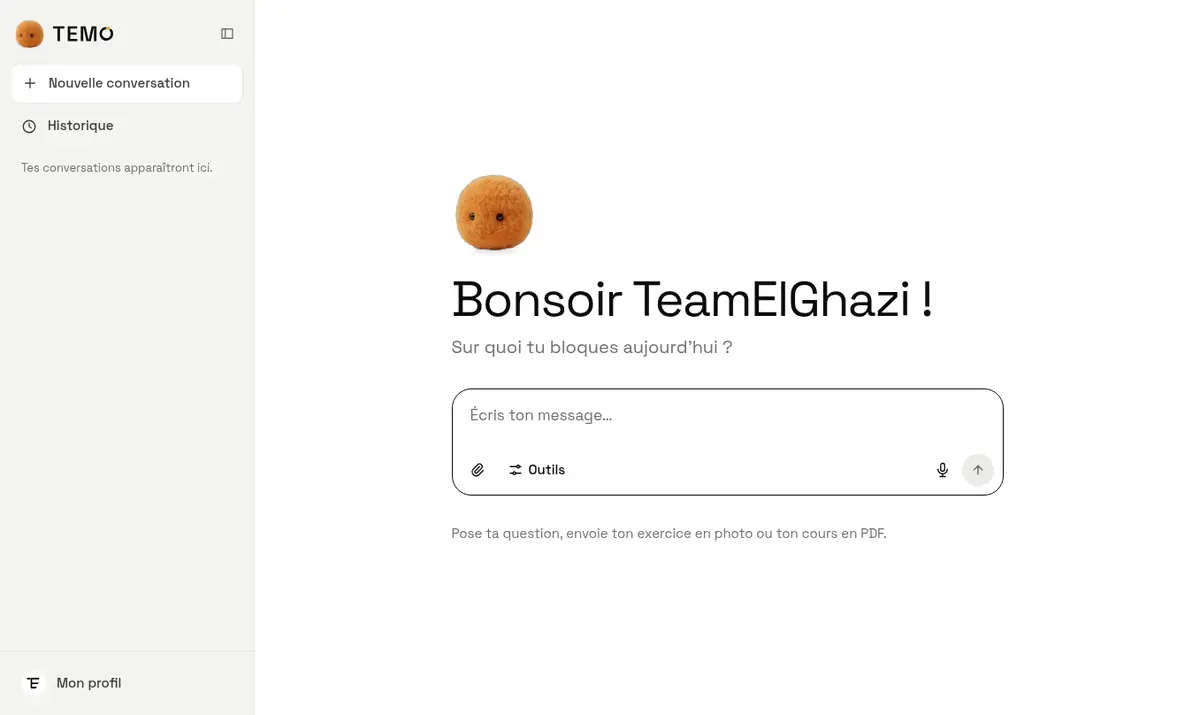
TEMO, the TeamElGhazi AI tutor
What was done
An in-house product, from middle school to university, in French, Arabic and English: it gives a hint rather than the solution
When
In service at temoby.teamelghazi.com

TEMO, AI tutor

It gives the hint. Not the answer.

Format
Web app, installable on a phone
For
Students, parents, tutoring centers, private tutors, schools
The case study
Products and publishing
Frequently asked questions

Your questions
about Middle East.

8 answers

Does TeamElGhazi work in the Middle East?

Yes, mostly remotely: live courses, automations, websites and consulting. We also work on site with our collaborators when a workshop or a rollout calls for it.

Do you have an office in the Gulf?

Our headquarters is in Casablanca, Morocco. Projects in the region are run online, and we open an office where demand grows.

What time are the sessions for the Gulf?

During office hours in your country. With a 3 to 4 hour lead over Casablanca, a Moroccan morning corresponds to late morning and early afternoon in the Gulf. The schedule is set with you at enrollment or in the proposal.

Can you deliver a website in Arabic and English?

Yes. We build bilingual or multilingual websites, with right-to-left Arabic. Our projects include riadhermes.com in 8 languages and cimemaroc.com in French and Arabic.

Are the courses taught in Arabic?

Yes, in Arabic, English, French or your group’s language from among 100. The trainer is live on Google Meet, and the exercises start from your own documents.

How do you comply with each country’s data laws?

Before setup, we write down where each piece of data goes and where it is stored. A server of your choice can host the system. Legal approval remains with your legal counsel.

How much does a project cost for a Gulf company?

Each project is priced with a custom quote, after a conversation about your needs. The quote specifies the deliverables, the schedule and the payment terms.

How do I get started?

Fill out the “Submit a request” form or book a 30-minute meeting on planning.teamelghazi.com. Tell us your country and your language: the reply comes in Arabic, English or French.

Your request

Your request
goes here.

in 106 languages
01 · Submit a request
Your request
You
At least one of the two: email or phone.
Sending

Your data is used only to reply to you (Law 09-08, GDPR). Privacy
02 · Meeting30 min

Individuals, institutions, companies: you choose your slot online. A first 30-minute conversation about a project, or your hours of lessons.

Choose a slot
03 · A call, an email06 60 66 59 52

Call us, or write to contact@teamelghazi.com

Service delivered in
  • 106 languages
From Casablanca: on site in Morocco, remotely everywhere.
Submit a requestMeeting