Python · October 16, 2026 · 7 min
Can you learn Python online in French or Arabic, and how do you choose a course?
Short answer: yes. Python code is written with a few dozen English keywords, but everything else (explanations, exercises, questions) can happen in French or Arabic, which makes the first weeks much easier. Choose a course with live sessions, recordings, weekly practice, a final project and a clear price, rather than the one with the most videos.
Many learners in Morocco, and Moroccans abroad, write to us with the same worry: “I want to learn Python, but most courses are in English and I lose track after ten minutes.” Others are parents looking for a tutor who can explain programming to a teenager in Darija or French. This guide answers both: why the teaching language matters less than you think for the code itself, but a lot for understanding, and what to check before paying anyone.
Why the teaching language matters for beginners
Programming asks you to learn two things at once: a new way of thinking (breaking a problem into steps) and a new syntax. When the explanation also arrives in a language you only half master, you have three difficulties instead of two. That is why so many self-taught beginners give up during the first month.
Learning in French, Arabic or Darija removes one of the three. You understand why a loop works before worrying about how to write it. The code still looks like this, in every language:
notes = [12, 15, 9, 17]
for note in notes:
    if note >= 10:
        print(note, "admis")
The keywords (for, in, if, print) are English, but the variable names and messages can be in any language. After a few weeks, the keywords become as familiar as “ok” or “stop”. Our Arabic-speaking readers can also read our step-by-step guide to learning Python from scratch, in Arabic.
Six checks before you pay for a course or a tutor
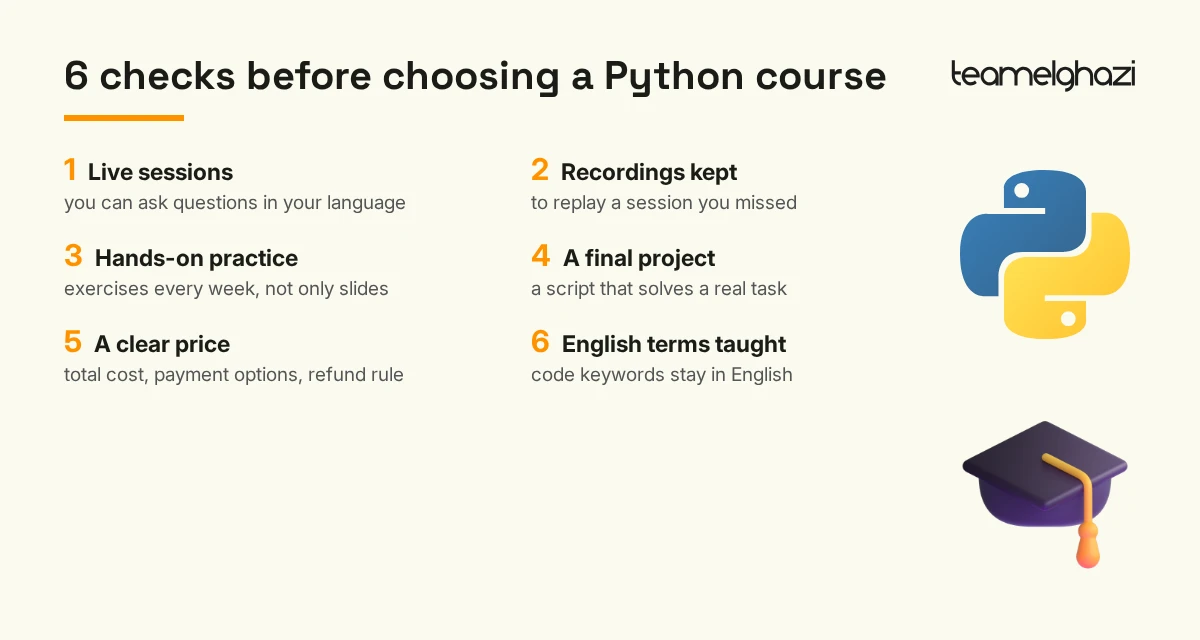
1. Live sessions, not only videos
Pre-recorded videos are cheap, but they cannot answer the question that blocks you on day three. A live session lets you ask, in the language you think in, why your loop never stops. If you choose videos only, make sure there is a real person who answers questions within a day.
2. Recordings you keep
Work, exams and family life mean you will miss a session sooner or later. Check that each session is recorded and that you keep access to the recordings after the course ends, so you can replay the part on functions or files when you need it again.
3. Practice every week
Nobody learns to code by watching. Ask how many exercises you will write and whether someone looks at them. A good course gives you small problems after every session and a place to run your code without installing anything complicated on the first day.
4. A final project
A certificate says you attended; a project shows what you can do. Prefer a course that ends with a script you built yourself, for example a program that renames hundreds of files, reads a CSV file and produces a summary, or sends a report automatically.
5. A clear total price and refund rule
Before you pay, you should know the total price, what is included, whether you can pay in installments and what happens if the first session does not suit you. Vague prices announced only by private message are a warning sign.
6. English terms taught, not hidden
Learning in French or Arabic is a real advantage for understanding, but error messages, documentation and keywords are in English. A good teacher explains in your language and also teaches you to read a Python error message in English, because you will see thousands of them.
A realistic roadmap for your first six weeks
Whatever course or tutor you choose, the basics follow roughly the same order. This is the order of our Python Fundamentals course:
- Algorithmic basics: variables, operators, loops, conditions and simple functions.
- Data structures: lists, dictionaries, tuples and set operations.
- Files: reading and writing text, CSV and JSON files.
- Standard modules: math and random, datetime, os and sys.
- Code quality: clean code, docstrings and exceptions.
- Final project: an automation script, documented and run from the console.
If a programme skips files and jumps straight to “AI with Python” in week two, be careful: you will copy code without understanding it. Files and dictionaries are where Python becomes useful in real jobs.
Private tutor or live group course?
- A private tutor suits a learner who needs a very flexible schedule, a teenager preparing a specific school exam, or someone stuck on one precise topic.
- A live group course suits most adult beginners: a fixed rhythm, a clear programme, a project and a lower price per hour. Other learners' questions often unblock you too.
What it costs at TeamElGhazi
Our courses run live on Google Meet; every session is recorded and stays available, and learners practise on our online platform. You can ask your questions in French, Darija or English.
- Python Fundamentals: 1,000 MAD, 1.5 months, live online, final automation project.
- Data Science & AI: 3,000 MAD, 4 months online (pandas, scikit-learn, neural networks).
- Automation & No-Code (n8n and Make): 1,500 MAD, 1.5 months, a good next step if you want to automate business tasks. See also what SMEs should automate first.
Each course ends with a validated project and a training certificate. If the first live session does not suit you, you can ask for a refund minus the 100 MAD registration fee. Payment is possible by bank transfer, card link, CashPlus or Wafacash, and in installments for some courses. All details are on our FAQ and the course catalogue.
Frequently asked questions
Can I really learn Python if my English is weak?
Yes. Python uses about thirty English keywords (if, for, while, def, return, import...), and you learn them like vocabulary. Explanations, exercises and questions can all happen in French or Arabic; only the code itself stays in English.
Is a private tutor better than a group course?
A private tutor adapts to your pace but usually costs more per hour. A small live group gives you a fixed schedule, a project and classmates who ask the questions you had not thought of. For most beginners, a live group course plus a few minutes of questions at the end of each session is enough.
How long does it take to learn the basics of Python?
With two or three live sessions a week and some practice between them, most beginners are comfortable with variables, loops, functions and files in about six weeks. Our Python Fundamentals course is built on that rhythm: 1.5 months, live online.
How much does a Python course cost at TeamElGhazi?
Python Fundamentals costs 1,000 MAD for 1.5 months of live online sessions, with recordings and a final automation project. To go further, Data Science & AI or Full Stack Developer cost 3,000 MAD each for 4 months.
Tell us your level and the language you are most comfortable in.
Ask about the next group