Getting started · November 3, 2026 · 7 min
Is learning to code hard?
By Abdellah El Ghazi, computer science teacher and founder of TeamElGhazi
Short answer: yes, the first week is hard, because you have to learn to break a problem into small steps and to read error messages. After that, the real difficulty is staying consistent: with a short session most days, an adult beginner writes their first useful scripts within a few weeks.
"I've never written code, I'm over 30 and I was never a math person. Can I actually do this?" We hear this all the time, and lately with a twist: "If AI writes the code now, is it even worth learning?" Here is an honest answer, with no miracle promises.
What is genuinely hard at the start
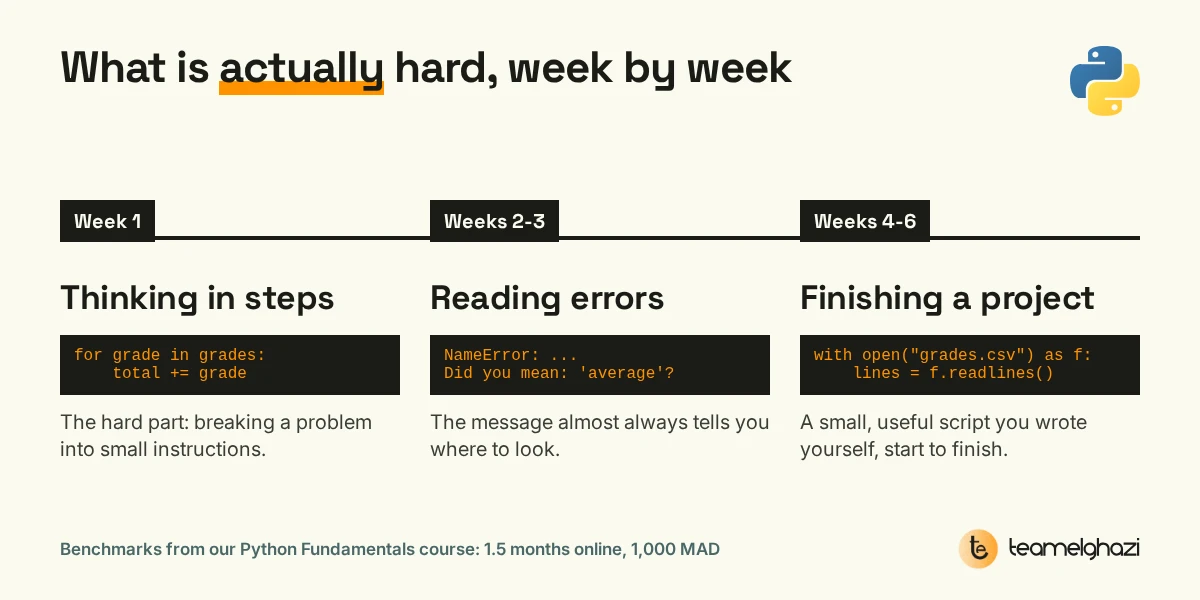
1. Thinking in steps
A computer guesses nothing. To average three grades, you have to spell it out: add the grades, count them, divide. That breakdown feels obvious to a person, yet it is the core skill of programming, and it takes far more effort at first than the syntax of any language.
2. Error messages
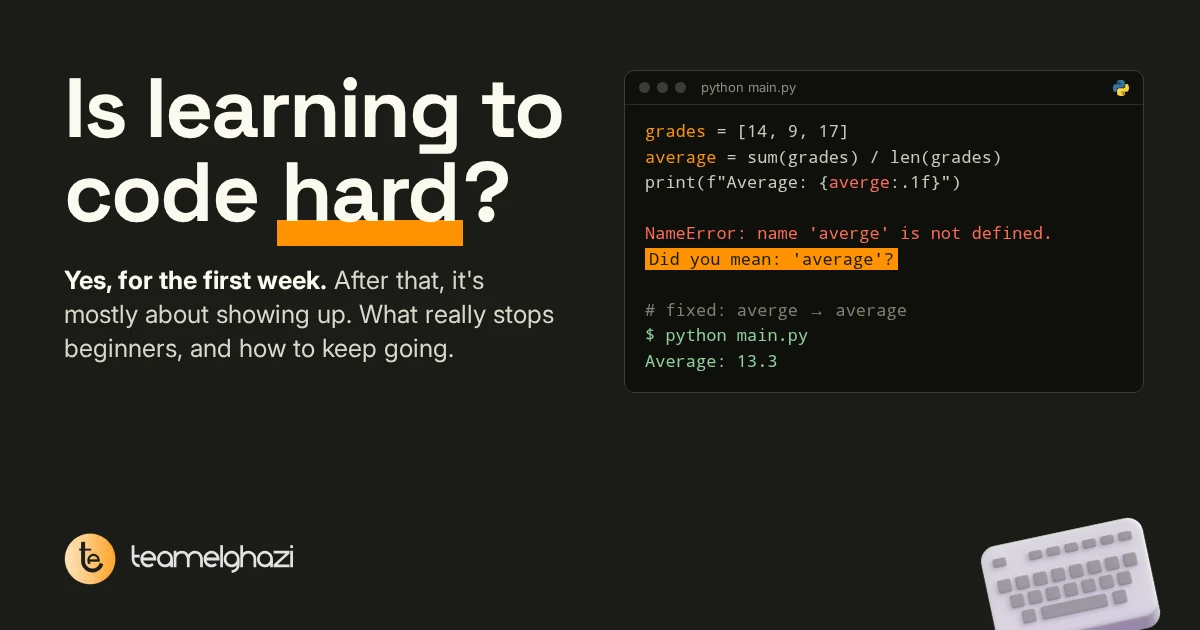
In the first days, your program crashes a lot. Beginners see a red block of text and decide they are not cut out for this. In fact, the message is on your side. In the example on our cover, Python prints NameError: name 'averge' is not defined. Did you mean: 'average'?: it points to the line, the misspelled name and the fix. Learning to read these messages is half the battle.
3. Consistency
Most beginners don't quit because it is too hard; they quit because they stop for ten days and forget everything. Half an hour on most days beats four hours every Sunday: your brain keeps what it sees often.
What is not an obstacle
- Advanced math: to begin, addition, averages and percentages are enough.
- Perfect English: about thirty words keep coming back (if, for, print, error…) and you pick them up as you code. The lessons themselves can be in French or Arabic.
- A powerful computer: an ordinary laptop handles Python and web development.
- Your age: children can start at 8 with blocks (see what age kids can start coding), and adults at 45 to automate their own work.
Does AI change everything?
Assistants such as ChatGPT, Claude or Cursor write code in seconds. That makes programming more accessible, not pointless. To use them without getting burned, you need three skills: describe exactly what you want, read the code they give you, and check that it really does the job. Those are precisely the basics a beginner learns.
Our advice: learn the basics by typing the code yourself, then use AI to go faster. Copy-pasting without understanding feels like progress until the first bug you cannot explain.
How long should you plan for?
There is no universal timeline, but here is a concrete benchmark. Our Python Fundamentals course runs for 1.5 months, live online: variables and operators, loops and conditions, functions, lists and dictionaries, reading CSV and JSON files, then a final project, a documented automation script. The first weeks go into logic and errors; the last ones into finishing something that works. Our guide Learning Python from scratch in Morocco lists the steps and free tools.
Where to start, depending on your goal
| Your situation | Course | Format | Price |
|---|---|---|---|
| You are starting from zero and want to understand code | Python Fundamentals | Online, 1.5 months | 1,000 MAD |
| You want to build a website or a tool with an AI assistant | AI, Vibe Coding & Web | Online, 2 months | 1,200 MAD |
| You want to automate tasks without writing code | Automation & No-Code | Online, 1.5 months | 1,500 MAD |
| You are aiming for a web developer job | Full Stack Developer | Online, 4 months | 3,000 MAD |
| It is for a child aged 8 to 11 | Scratch for Kids | Online, 1 month | 1,100 MAD |
Three habits that make it harder than it is
- Switching languages every two weeks. Python, then JavaScript, then something else: you keep restarting from zero. Stick with one language until your first project is done.
- Watching videos without typing code. It feels like understanding, but your hands learn nothing. Redo every example, then change it.
- Staying stuck alone. An error that costs you two hours often takes two minutes for someone who has seen it before. That is the point of a live class with a trainer.
The bottom line
Programming is not reserved for math geniuses. The first week is hard, then it becomes a habit. Pick one language, practise a little every day, learn to read errors and finish a small project. To compare all our courses, see the Courses page; for a specific question, write to us from the Contact page or check the FAQ. Our center is at 26 rue Nahas Nahoui, Maarif (Casablanca), and adult courses are also taught online.
Frequently asked questions
Do I need to be good at math to learn programming?
No. To get started you only need addition, averages and percentages. Advanced math matters in some fields (data science, 3D games, machine learning) and you can learn it when you get there.
How long does it take to learn the basics?
A few weeks of regular practice. Our Python Fundamentals course covers the basics in 1.5 months, live online, for 1,000 MAD: variables, loops, conditions, functions, CSV and JSON files, then a small final project.
With AI writing code, is it still worth learning?
Yes, in a different way. An AI assistant writes code fast, but you still have to read it, test it and explain what you want. That is exactly what the basics teach. Our AI, Vibe Coding & Web course (1,200 MAD, 2 months online) shows you how to work with Cursor and Claude.
Can I take the classes online from outside Casablanca?
Yes. Python Fundamentals, AI, Vibe Coding & Web, Automation & No-Code and Full Stack Developer are all taught online, so you can join from any city in Morocco or abroad.
Ready to write your first program?
See Python Fundamentals