Data · November 19, 2026 · 6 min
Becoming a data analyst in Morocco: which course should you take first?
By Abdellah El Ghazi, computer science teacher and founder of TeamElGhazi (Maarif, Casablanca)
Short answer: start with what you already use, Excel, then learn Power BI to build dashboards (1.5 months), then Python to clean and analyse data at scale (1.5 months, plus 4 months of data science if you want the job title). Three tools in that order beat ten tools started at once.
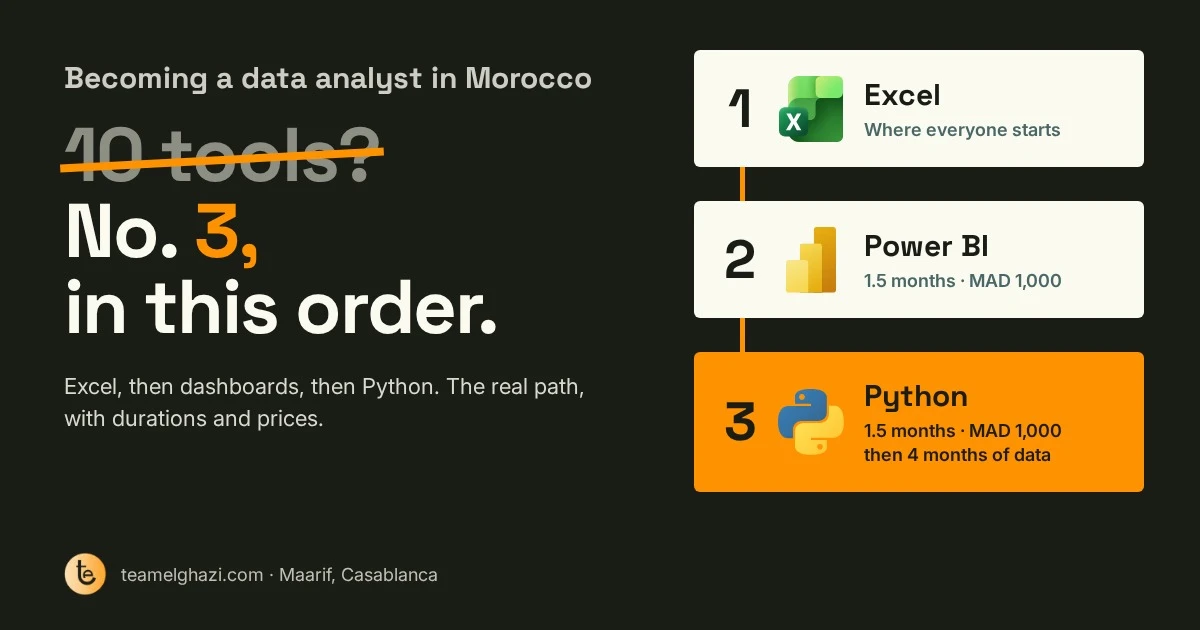
"I want to become a data analyst. Where do I start?" We get this from very different people: an office administrator who lives in spreadsheets, an economics graduate who keeps seeing "Power BI" in job ads, a sales rep who wants to finally understand their own numbers. Online, the usual answer is a list of ten tools: Excel, SQL, Power BI, Tableau, Python, R, statistics, AI… So many people start everything and finish nothing.
Here is the order we recommend, based on the actual syllabus of our courses and on what we see with learners.
What a data analyst actually does
A data analyst answers business questions with data: "Which products sell least in Casablanca this quarter?", "Why do absences rise in November?", "Which salesperson has the most unanswered quotes?". The job comes down to four moves: collect the data (files, software, databases), clean it (duplicates, blanks, badly typed dates), analyse it and present it clearly to someone who has to decide. Every tool on the path serves one of those moves.
Step 1: Excel, the starting point
Before any course, check that you can sort, filter, write simple formulas (SUMIF, XLOOKUP or VLOOKUP) and build a pivot table. If you can, you already have the foundation. If not, a few weeks of practice on your own files is usually enough. To know when Excel stops being enough, read Excel or Power BI: when should you switch to a dashboard?
Step 2: Power BI, to make the numbers visible
This is the step that changes your working week fastest. In Power BI Beginner (1.5 months, online, MAD 1,000) you learn to import and clean data with Power Query, link several tables, write the essential DAX measures and publish a dashboard that refreshes itself. The final project is a real decision dashboard, with a PDF report and a KPI presentation.
Why before Python? You stay close to Excel, results show up immediately, and it is what many Moroccan companies need first: all their figures in one place, without rebuilding the report every Monday.
Step 3: Python, to go further
Python earns its place when files are too big for Excel, when the same cleaning has to run every day, or when you need analysis Power BI can't do. Python Fundamentals (1.5 months, online, MAD 1,000) covers variables, loops, functions, lists and dictionaries, reading CSV and JSON files and error handling, with an automation script as the final project. Our article how long does it take to learn Python? walks through those six weeks.
The full path, month by month
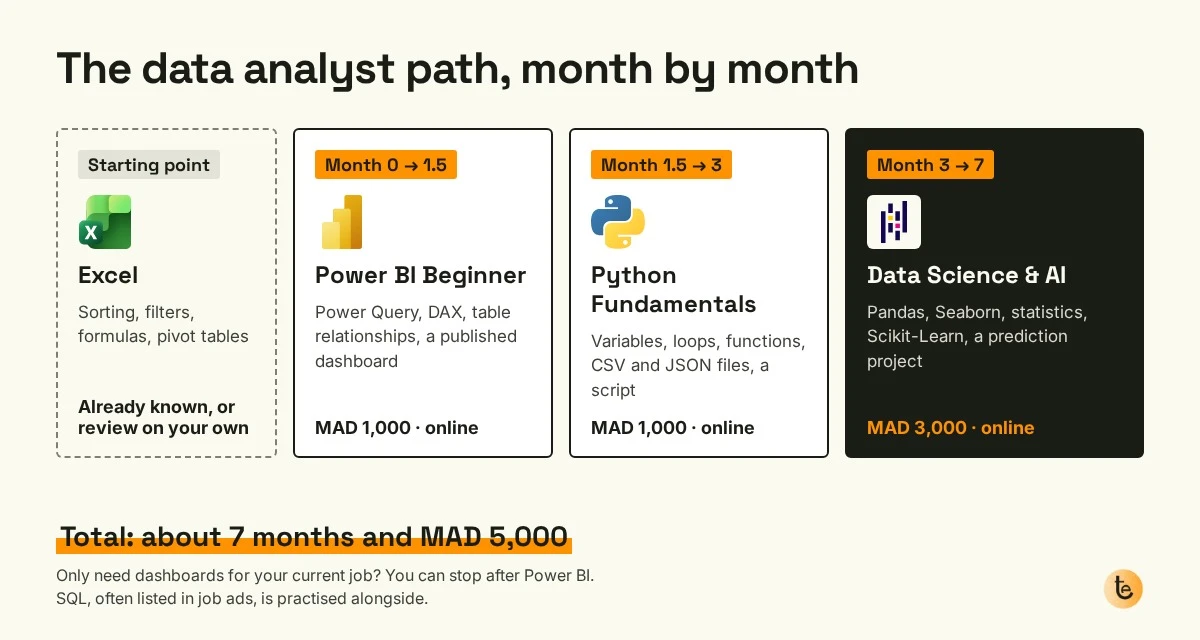
If you are aiming for a junior data analyst or data scientist role, the next step is Data Science & AI (4 months, online, MAD 3,000): data cleaning with Pandas, charts with Seaborn, descriptive statistics, Scikit-Learn algorithms, first neural networks and a complete prediction project. In total, plan for about 7 months and MAD 5,000, online, from Casablanca or anywhere in Morocco. No course length guarantees a job: your projects are what convince employers.
Four mistakes that cost months
- Learning ten tools at once. Tableau and Power BI do the same job: pick one. Same for Python and R.
- Watching tutorials without practising. Open a real file (sales, absences, expenses) and build one chart tonight.
- Skipping SQL. It appears in many job ads. We don't have a separate SQL course, so practise it alongside, on your project data.
- A portfolio made only of sales dashboards. Mix topics: schools, health, transport, e-commerce. It shows you can ask questions, not just copy a template.
What if you don't want to change careers?
Many employees don't need the data analyst title, just faster reports. In that case Power BI alone is often enough. If your real problem is copying data from one tool to another, look at Automation & No-Code (n8n, Make). Unsure about the format? The Python course in Casablanca page explains how our live online classes work, and every course is listed on the courses page.
Frequently asked questions
Do I need a computer science degree to become a data analyst?
Not to start learning. Plenty of data analysts come from accounting, business, sales or engineering. What matters at the beginning is being comfortable with Excel and basic logic. Employers then look at what you can show: a dashboard, an analysis, a project.
Should I start with Power BI or Python?
If you already work in Excel, start with Power BI: you will build useful dashboards within a few weeks. Python comes next, when files get too heavy or work needs automating. Power BI Beginner and Python Fundamentals each take 1.5 months, online, for MAD 1,000.
How long and how much for the full path?
About 7 months and MAD 5,000 at TeamElGhazi: Power BI Beginner (1.5 months, MAD 1,000), Python Fundamentals (1.5 months, MAD 1,000), then Data Science & AI (4 months, MAD 3,000). You can stop after Power BI if dashboards for your current job are all you need.
What about SQL?
SQL shows up in many data analyst job ads. We don't run a separate SQL course: table relationships are covered in Power BI, and you should practise SQL queries alongside, for example on the data from your own projects.
More answers on our FAQ.
Tell us where you're starting from (Excel, studies, current job) and we'll point you to the first step, free of charge.
Contact us