Kids · November 20, 2026 · 6 min read
Scratch, Arduino or Python: which first coding class for your child?
By Abdellah El Ghazi, computer science teacher and founder of TeamElGhazi (Maarif, Casablanca)
Short answer: between 8 and 11, start with Scratch, which teaches coding logic with blocks and ends with a real little game. From 10, Arduino suits kids who want to make physical things move, and Python becomes the right pick around 12, once your child is comfortable on a keyboard.
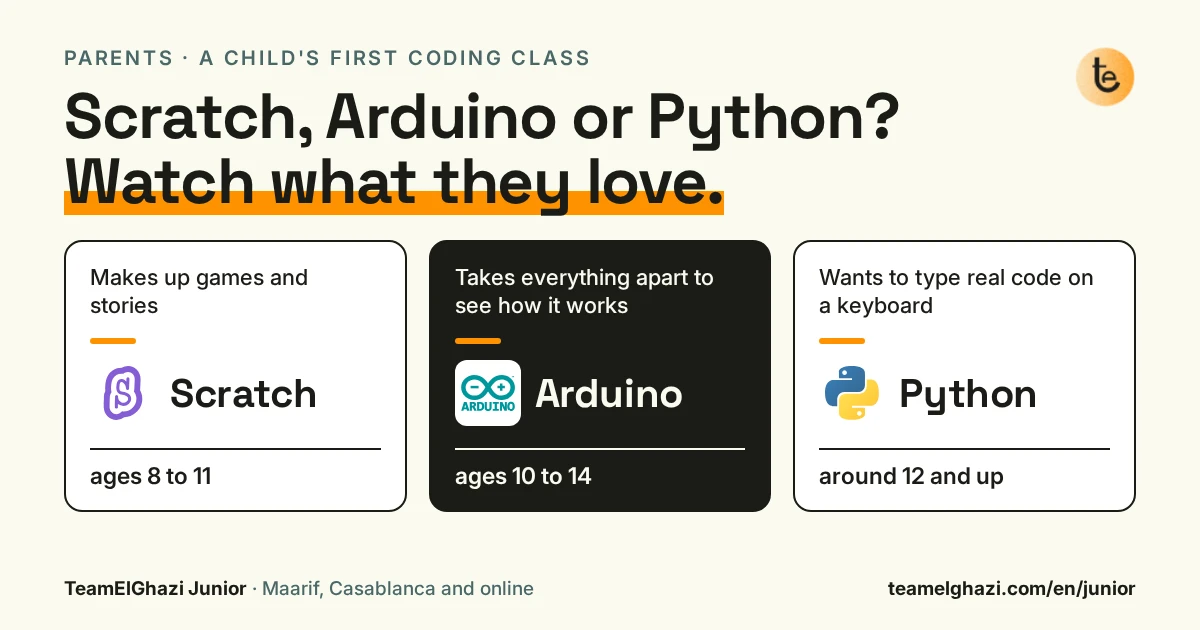
"Someone told us about Scratch, Arduino, Python... which one do we pick?" After "is my child old enough?", it's the question parents ask us most. All three are great tools, but they solve different problems. Pick the wrong one at the wrong time and you risk a child who gives up after three sessions, saying "it's too hard" or "it's for little kids".
If you're still wondering whether your child is ready at all, read our guide what age can a child start coding? This article assumes they're ready and focuses on where to begin.
What each tool actually teaches
Scratch is a free, block-based language created at MIT. Kids snap pieces together ("move 10 steps", "if on edge, bounce") and see their character react instantly. Typos are impossible, so all their attention goes to the logic: loops, conditions, and variables such as a score or a number of lives.
Arduino is a small electronics board you program to control LEDs, buttons, sensors and motors. The code is simplified C++, but it stays short: kids write it because they need it to make their build work. Along the way they learn what a circuit, a resistor and a servo motor are.
Python is a real professional language, used in data, artificial intelligence and automation. It's readable, but it asks you to type precisely, read error messages and stay patient in front of a screen full of text. It makes an excellent second step, and rarely the best first step before 12.
Match the tool to what your child loves
- Invents games, stories or cartoons → Scratch. They can build their own game in the first week, and that fun is what keeps them going.
- Takes toys apart, loves Lego Technic or small robots → Arduino, from age 10. Seeing an LED light up because you wrote the right line is the moment these kids get hooked.
- Fast on a keyboard, curious about "how real programmers do it" → Python, from around 12, ideally after some Scratch.
- Mostly into 3D video games → from 12, a 3D game project is often more motivating than a language course.
Torn between two? Pick the simpler one. A child who succeeds with Scratch moves to Python in a few weeks; a child put off by Python at 9 doesn't always come back to coding.
Our programs, age by age
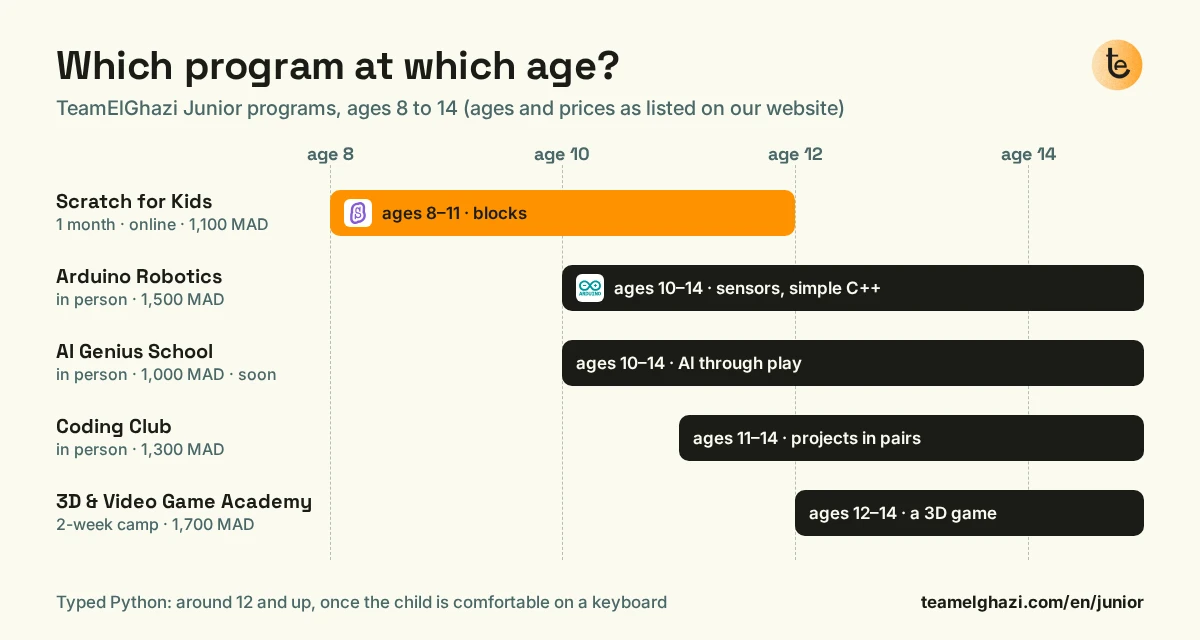
Here's what TeamElGhazi Junior offers, with the ages and prices shown on each program page:
- Scratch for Kids: ages 8 to 11, 1 month, online, 1,100 MAD. Movement, sounds, variables, collisions, and a complete story game as the final project.
- Arduino Maker Robotics: ages 10 to 14, in person in Casablanca, 1,500 MAD. LEDs, buttons, servo motors, sensors, basic C++, and an obstacle-avoiding robot at the end.
- Youth Programming Club: ages 11 to 14, in person, 1,300 MAD. Scratch blocks first, then logic challenges in pairs, for kids who enjoy working in a group.
- 3D & Video Games Academy: ages 12 to 14, 2-week camp, 1,700 MAD, with a playable 3D game as the final project.
- The AI Geniuses School (ages 10 to 14, 1,000 MAD) is listed as "coming soon": AI explained through play, with a simple chatbot and sensors.
We don't run a Python course just for kids. For a teenager who is already comfortable, let's talk: depending on their level, they can join Python Fundamentals (6 weeks, online, 1,000 MAD), our beginner course.
3 questions to ask before you sign up
- What will my child be able to show at the end? A game, a robot, a small app: a concrete project beats a list of topics.
- How many kids per group, and what ages? An 8-year-old and a 13-year-old don't move at the same pace.
- Online or in person? Scratch works very well remotely; Arduino, with hardware to wire up, works better in a classroom. Our article online or in-person training compares both formats.
Frequently asked questions
My child is 9: Scratch or Python?
Scratch, almost every time. At 9, typing lines of code without typos is still frustrating. With Scratch blocks, kids learn the same ideas (loops, conditions, variables) and finish a real game. Python comes much faster afterwards, around age 12.
Isn't Arduino too technical for a child?
Not from about age 10, with a teacher in the room. Kids wire LEDs, buttons, sensors and small motors, then write a few lines of simplified C++ to make them react. Our Arduino Maker Robotics program (ages 10 to 14, in person, 1,500 MAD) ends with a robot that avoids obstacles.
Do I need to buy a computer or a kit first?
For Scratch, a computer with a web browser and an internet connection is enough: the class is online. Arduino sessions are in person, so ask us what your child should bring before you sign up, rather than buying a random kit.
My child is 13 and has never coded. Where should they start?
At 13, a child who is comfortable on a keyboard can skip Scratch, or join the Youth Programming Club (ages 11 to 14, in person, 1,300 MAD), which starts with blocks and moves quickly. If they mostly want to make games, the 3D and Video Games Academy (ages 12 to 14, 2-week camp, 1,700 MAD) is a great way in.
More answers on our FAQ, and every program on the courses page.
Tell us your child's age and what they love: we'll recommend the right first class, free of charge.
Contact us