Schools · November 5, 2026 · 5 min
Ban AI at school or guide it? The 5 rules of a one-page school AI policy
By Abdellah El Ghazi, teacher, trainer and founder of TeamElGhazi (Casablanca)
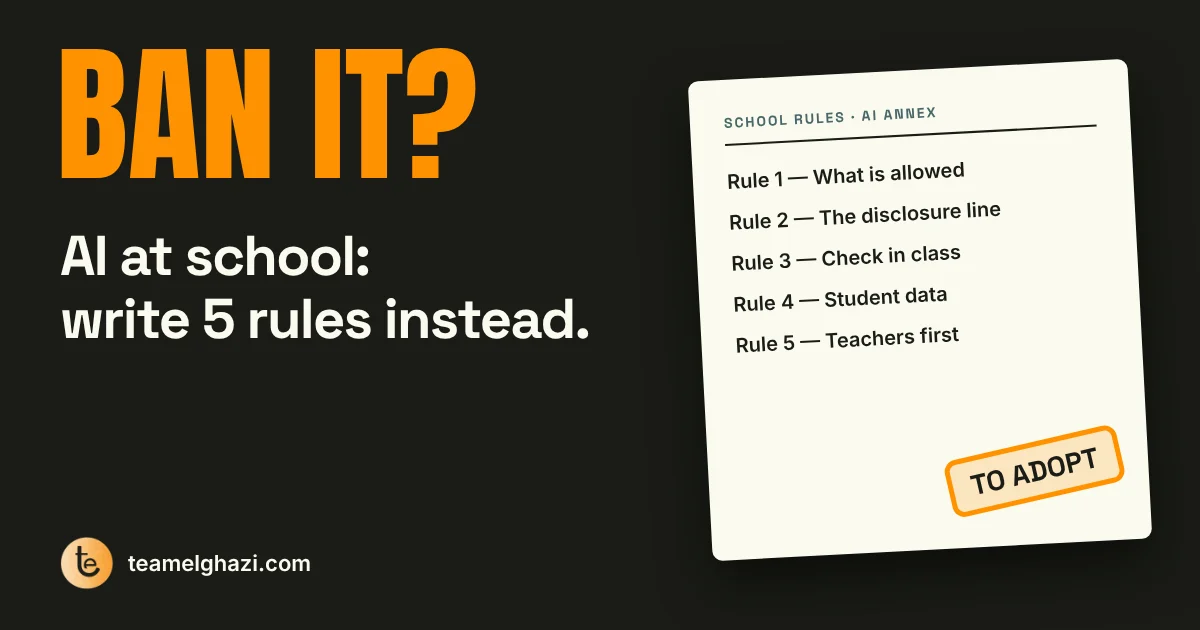
Short answer: instead of banning AI, add a one-page annex with 5 rules to your school rules: what is allowed, a disclosure line on every assignment, checking understanding in class, no student data in unapproved tools, and teacher training before requiring anything. Review it every term.
This week in the United States, the debate over whether schools should ban or guide AI flared up again. School leaders everywhere are asking the same question. It is a fair one, but a ban has a limit: it says what not to do without saying how to work. Students keep AI in their pocket, and teachers are left alone with each case.
The useful question is simpler: do teachers, students and parents know what is allowed? If not, one page is enough to start. Here are the 5 rules I would add to the school rules.
The 5 rules of the AI annex
Rule 1 — Say what is allowed, not only what is banned
A rule that only says "no" pushes students to use AI in secret. A rule that says "yes, for this" gets respected. Sample wording: students may use AI to find ideas, rephrase a passage or practice with questions; they may not hand in work written by AI as if it were their own.
Rule 2 — A disclosure line on every assignment
At the bottom of the page, the student writes: "AI used: yes / no — for what". For example: "AI used: yes — to fix the spelling in my introduction." Students learn to explain how they worked, and teachers know what to check.
Rule 3 — Check understanding in class
A bit more writing in class, and two minutes of oral questions: "Explain this paragraph to me", "Why did you choose this example?". Understanding shows right away, with or without AI. It is also the fairest answer to the homework problem.
Rule 4 — No student data in a tool the school has not approved
No names, grades, medical records or photos of students in an AI tool the school has not chosen. To ask for help on a case, write "Student A". The rule applies to teachers and office staff alike.
Rule 5 — Train teachers before you require anything
You cannot ask teachers to enforce a rule about a tool they have never used. Start with a hands-on workshop where everyone tries AI on a real lesson from their subject, then a one-term trial, then a review of the policy with their feedback.
How to roll it out in one term
- Week 1: leadership and three or four volunteer teachers adapt the 5 rules to the school (elementary, middle, high school or training center).
- Week 2: a hands-on workshop for staff, on real lessons.
- Week 3: present it to students and send it to parents, with the disclosure line to copy.
- End of term: review with teacher feedback; keep what works, fix the rest.
Three common mistakes
- A ten-page policy. Nobody reads it. One page, five rules, examples.
- Relying on an AI detector. None is 100% reliable; a two-minute oral check is far more dependable.
- Forgetting the front office. The data rule also covers staff who use AI to draft letters or reports.
And for the time saved in the office
AI at school is not only about homework. It is also paperwork: enrollment, attendance, fee reminders, certificates. I gathered the 10 tasks a school can hand over to a machine in a free PDF guide. For ready-to-use course materials and programs, see our teaching materials page; for universities and colleges, the higher education page.
Frequently asked questions
Should a school ban ChatGPT and AI tools?
A ban says what not to do, but not how to work. Students still have AI on their phones outside school. A policy that lists allowed uses, asks for a disclosure line and checks understanding in class is easier to enforce.
Who should write the AI policy?
School leadership owns it, but it works better when a few volunteer teachers from different subjects help write it, before it is presented to students and parents. One page is enough to start, added to the school rules as an annex.
How can a teacher tell if homework was written by AI?
No detection tool is 100% reliable, and accusing a student based on a detector alone is risky. A disclosure line on every assignment and two or three oral questions work better: a student who understood the work can explain it.
Can staff use AI with student data?
Only in a tool the school has chosen and whose data terms it knows. In every other case, remove names, grades, health information and photos, and refer to "Student A".