Schools and training centres · November 19, 2026 · 5 min
AI eases teachers' workload, not their hours: where is the time to win back?
By Abdellah El Ghazi, trainer and founder of TeamElGhazi (Maarif, Casablanca)
Short answer: teachers mostly use AI to prepare lessons, and the time saved is often reinvested there. The hours that weigh on the team's evenings come from repetitive admin tasks that a chatbot does not touch. To win them back, measure those tasks, automate one at a time with a human check, and decide in advance what the freed-up time is for.
What the Bett / YouGov 2026 survey says
The report "AI in Education 2026: Working it out", published by Bett from a YouGov survey of 1,033 teachers in the United Kingdom, asks a simple question: does AI really save time? The answers:
- 8 in 10use AI for teaching-related tasks.
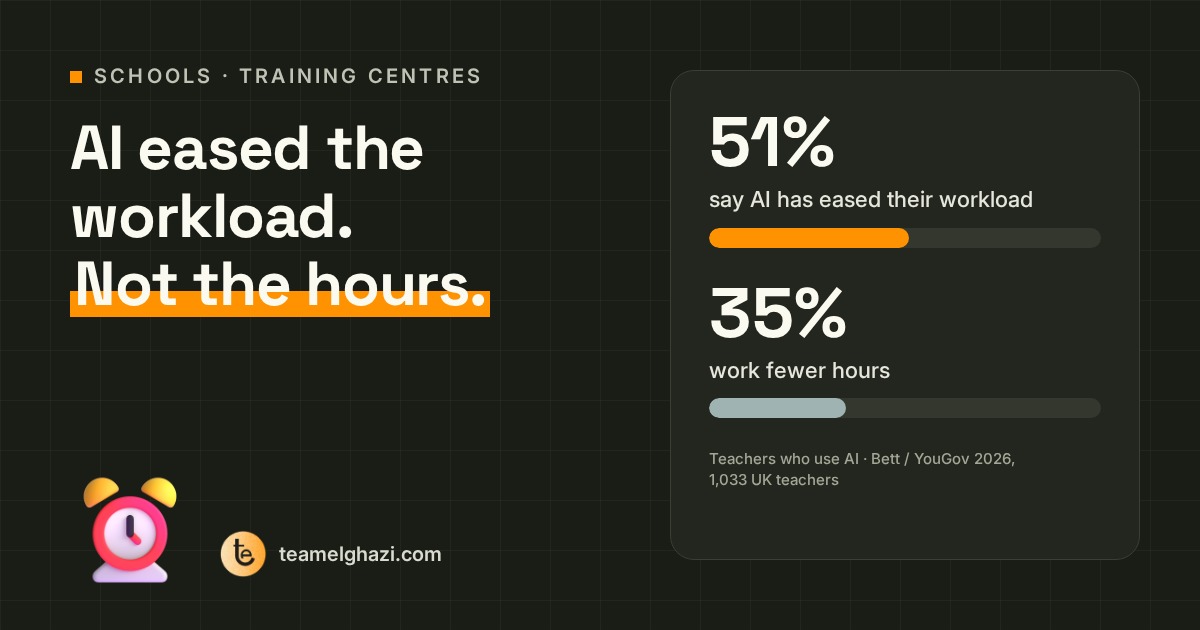
- 51%of teachers who use AI say it has eased their workload.
- 35%say they work fewer hours; more than half work the same hours as before.
- 76%use it to create lesson plans, worksheets and learning resources.
- 41%have received no AI training from their school.
Weekly use has doubled in a year (52% vs 26%), but enthusiasm is falling: 47% expect to use AI more next year, down from 68% a year earlier. Almost half of teachers also say their school has no written policy on staff use of AI.
Why the time saved does not show up in working hours
The survey does not give the reason. Here is my reading, based on what I see in the schools and training centres I work with:
- AI goes where the work is creative. A worksheet gets done faster, so teachers make a second, differentiated one. The work is better; the hours stay the same.
- The heavy tasks are not conversations. Reminding ten families, counting the month's absences, copying attendance sheets, generating certificates: these are sequences of actions on lists. A chat assistant does not do them on its own.
- Nobody measures. Without a starting point, freed-up time is neither visible nor protected.
Where to find the hours: 4 steps for school leaders
1. Measure one week, not a feeling
For one week, the office team and two or three teachers log the time spent on recurring tasks: reminders, absences, attendance sheets, invitations, certificates. A simple spreadsheet is enough.
2. Pick a single task
A good first task comes back every week, follows a clear rule ("remind three days before the due date") and involves little sensitive data. Fee reminders or meeting invitations are often good candidates.
3. Automate with a human check
The machine prepares the message, the table or the PDF; a person reviews and approves. Tools you often already have are enough to start: Google Forms, Google Sheets, Google Calendar, WhatsApp Business, and n8n when several tools need to be connected.
4. Make the saved time visible
Measure again a month later, and decide in advance what the freed-up time is for: following struggling students, talking with families, planning together. Otherwise it disappears into new tasks.
Going further
- The full list of tasks to hand over to a machine, with before / after and tools: the free PDF guide 10 admin tasks to automate in your school.
- To pick the first one: school paperwork, where to start.
- To have it set up: automation for training organisations (quote on request).
- To train teachers in practical uses of AI, data protection included: the AI-Augmented Teacher course (2 months online, 1,500 MAD, teams on quote).
Frequently asked questions
Does AI really save teachers time?
It can, but the time does not always show up in working hours. In the Bett / YouGov 2026 survey, 51% of teachers who use AI say it has eased their workload, but only 35% say they work fewer hours. The gain depends on the task and on what happens to the time it frees up.
Which admin tasks should a school automate first?
The ones that come back every week, follow a clear rule and involve little sensitive data: acknowledging enrolment requests, fee reminders before the due date, invitations and day-before reminders, monthly attendance summaries, satisfaction surveys. The machine prepares, a person approves.
Should teachers be trained before automating?
Both go together. Automation removes repetitive tasks from the office and from teachers; training shows them how to use AI for teaching without exposing student data. In the Bett / YouGov survey, 41% of teachers had received no AI training from their school.
Sources: Bett, "AI in Education 2026: Working it out" (YouGov survey of 1,033 UK teachers), as reported by Tes Magazine (27/08/2026) and EdTech Innovation Hub (05/11/2026). The section "Why the time saved does not show up" is the author's analysis, not a survey finding.
Want to know where your team loses its hours? Let's talk about your school.
Request a quote